The instrument
The Coimbra guitar explained
What the Portuguese guitar is, how the Coimbra model differs from the Lisbon one, and what to listen for when the guitars start in a Coimbra fado concert.
Book the concert ↗Quick answer
The Coimbra guitar is one of two models of the Portuguese guitar, a teardrop-bodied instrument with twelve steel strings in pairs. Next to the Lisbon model it is longer in the string, tuned a major second lower and darker in tone. In Coimbra fado it strums chords beside a classical guitar instead of answering the singer's phrases, so it behaves like part of the accompaniment and not a second soloist.
The short answer
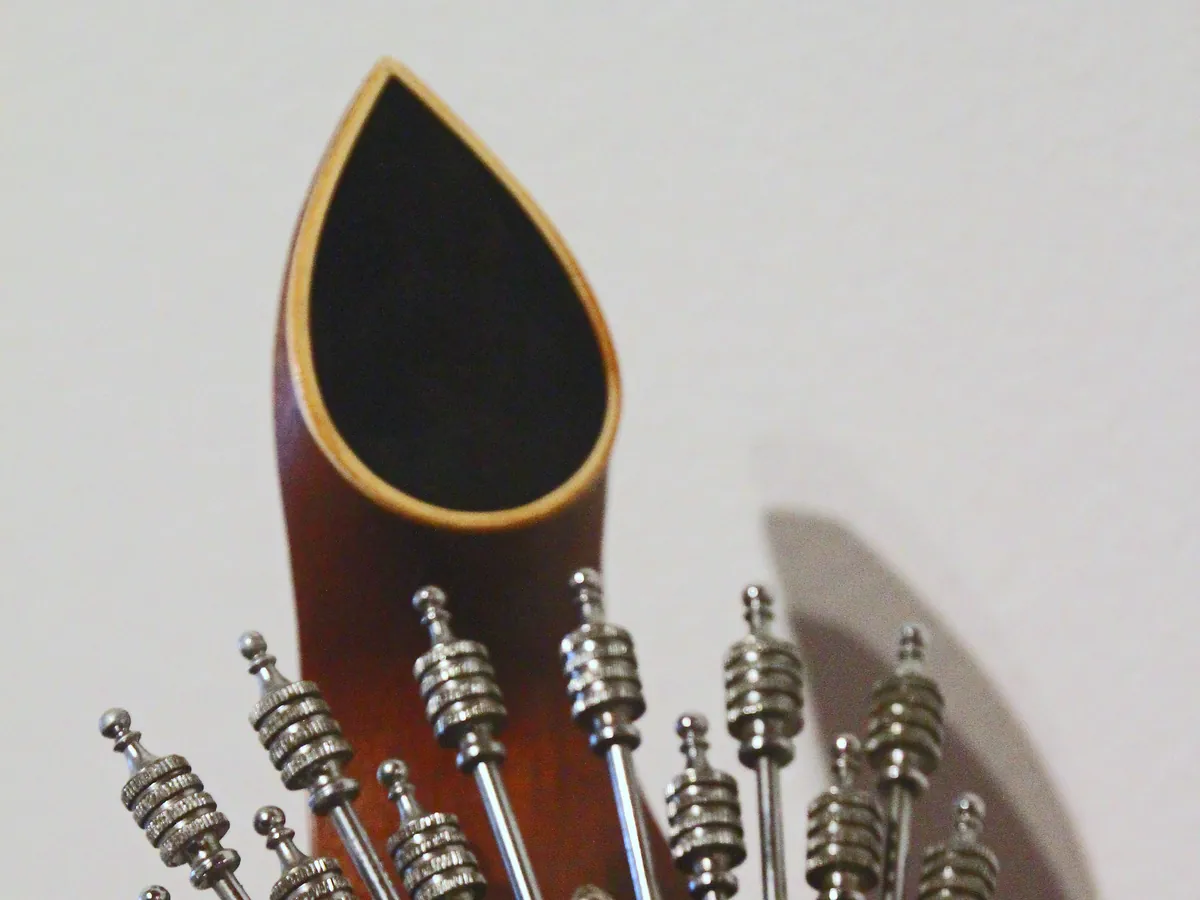
A Fado de Coimbra concert usually comes down to three sounds: a voice, a Coimbra guitar and a classical guitar. The Coimbra guitar is the small, rounded one with the fan of tuning keys. Wikipedia lists twelve steel strings arranged in six courses, and notes that it is among the few instruments still fitted with watch-key or Preston tuners. UNESCO's entry describes a cittern with a pear-shaped body and wire strings, found only in Portugal.
Where the instrument comes from
Wikipedia derives the Portuguese guitar from the medieval citole, which it says was in use in Portugal from the thirteenth century among troubadours and minstrels. It says the instrument went through a cittern and an English guitar phase and that, especially from the middle of the nineteenth century, it came into fashion through its link with Lisbon song. The Coimbra model is a later branch: the Coimbra fado article calls it a modified version of Lisbon's fado guitar.
Lisboa and Coimbra side by side
Wikipedia names two models, the Lisboa and the Coimbra, and lists what separates them. The Coimbra model is also simpler in construction, according to the same source.
- Free string length: 445 mm on Lisboa guitars, 470 mm on Coimbra guitars
- Tuning: the Lisboa model in D, brighter and more resonant; the Coimbra model in C, with a darker timbre
- Ornament: a scroll, the caracol, on the Lisboa; a teardrop-shaped lágrima on the Coimbra
- Soundboard: broader on the Lisboa model
What it does in the music
In Lisbon fado, the guitarrista plays an introduction and answers the singer's phrases in a call-and-response, Wikipedia says. In Coimbra fado, by contrast, the guitar plays the chordal accompaniment alongside the acoustic guitar. Wikipedia describes the usual pattern as a downstroke with the thumb followed by a rolled chord across all the strings, adapted to the time signature of the fado being played. The effect is a more continuous, strumming texture beneath the voice.
How the strings are picked
Wikipedia says the strings of the Portuguese guitar are picked with the corner of the fingernails, avoiding contact of the flesh with the strings, and that the unused fingers rest below the strings on a guard on the soundboard. Most players use fingerpicks, called unhas, which were traditionally made of tortoiseshell and are today usually nylon or plastic. Wikipedia adds one more difference between the models: Lisboa picks are commonly rectangular, for a clearer attack, while Coimbra picks tend to follow the natural curve of the fingernail.
The classical guitar beside it
Wikipedia says Coimbra fado is accompanied by the guitarra portuguesa and the viola, a kind of guitar. The UNESCO entry names the same pairing for fado at large: an acoustic guitar with steel strings beside the guitarra. In the concert photographs on this page, the two instruments are easy to tell apart: the pear-shaped guitar with a short neck and a fan of tuning keys, and the larger, orange-brown classical guitar with the familiar guitar outline.
A monument in the old town
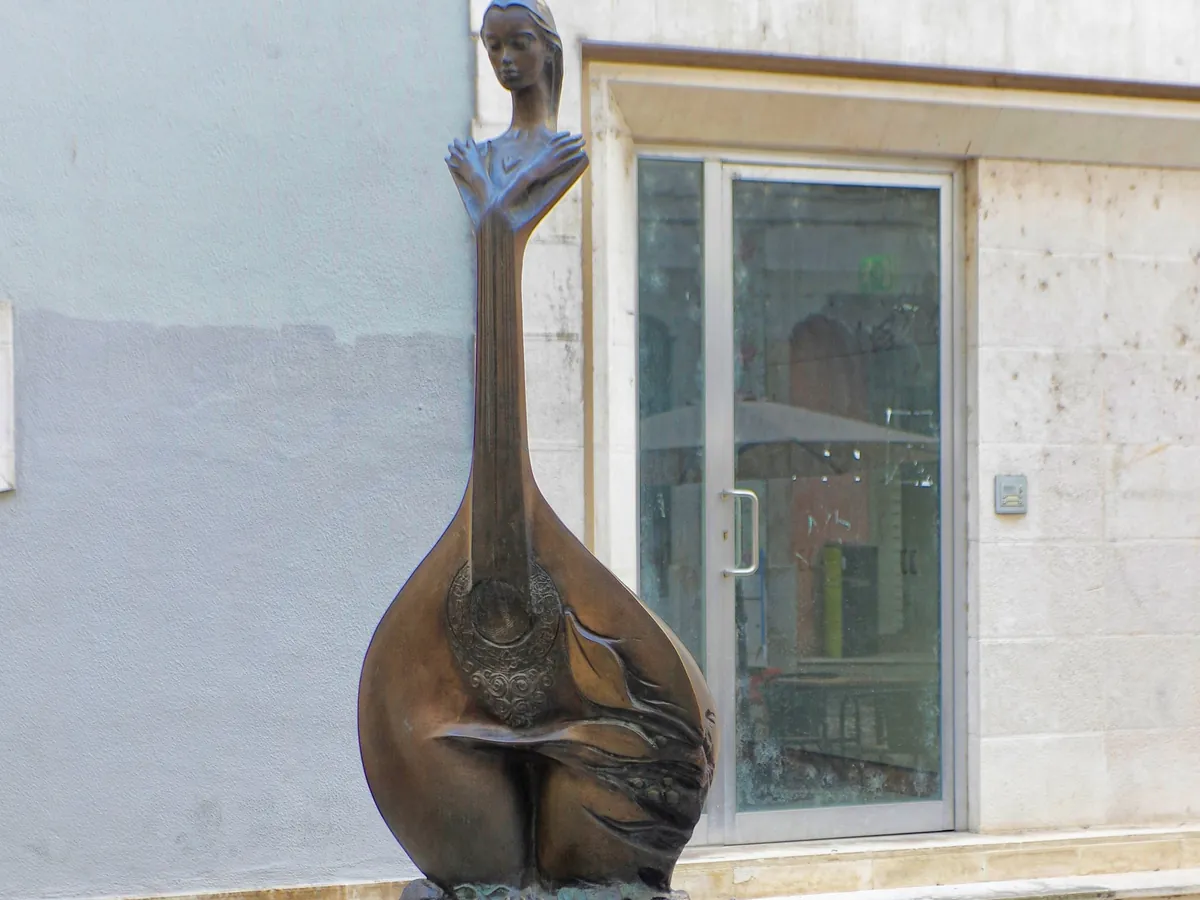
A bronze monument to fado stands in Coimbra's old town, shaped like a Portuguese guitar and photographed for Wikimedia Commons. The city's Walled Coimbra leaflet adds another place for the instrument: the Anto Tower, part of the old wall, is today the home of the Coimbra Guitar and Fado Interpretative Centre. Check the municipality's own notices for opening details before you plan a visit, because they change.
Who this isn't for
This page suits people who enjoy knowing what the instrument is doing. It keeps to the instrument and leaves out the players, so look elsewhere for a history of fado's great singers. Anyone who plays the Portuguese guitar will find technique, tuning and makers covered at length in Wikipedia's article, and the concert will tell you more about the sound than any description can.
Frequently asked questions
How many strings does a Coimbra guitar have?
Twelve steel strings, in six pairs, as on every Portuguese guitar, according to Wikipedia.
What is the difference between the Lisboa and Coimbra guitars?
The Coimbra model has a longer free string length, 470 mm against 445 mm, and is tuned a major second lower, with a darker timbre, Wikipedia says.
Is a Coimbra guitar just a classical guitar?
No. The classical guitar is the larger, six-string instrument that accompanies it. The Coimbra guitar is the pear-shaped, twelve-string one.
Where can I see the instrument in Coimbra?
The city's Walled Coimbra leaflet places the Coimbra Guitar and Fado Interpretative Centre in the Anto Tower. Check opening details before you go.
Sources